
The Widal test normal range is usually 1:20 or lower for both O and H antigens. A result of 1:80 is generally considered borderline, while 1:160 may indicate a possible active typhoid infection when combined with symptoms and fever history. However, a Widal test alone cannot confirm typhoid, and doctors often use a blood culture and clinical evaluation for an accurate diagnosis.
If you have received a Widal test report showing values such as TO, TH, AO, AH, 1:80, or 1:160, you may be wondering what these numbers actually mean. This guide also explains what a widal test positive means and how doctors use your results alongside your symptoms to decide the next steps. If you are new to the test itself, you can first read our guide on what a Widal test means. This article focuses specifically on Widal test report interpretation, including the normal range, common results, and when further testing may be needed.
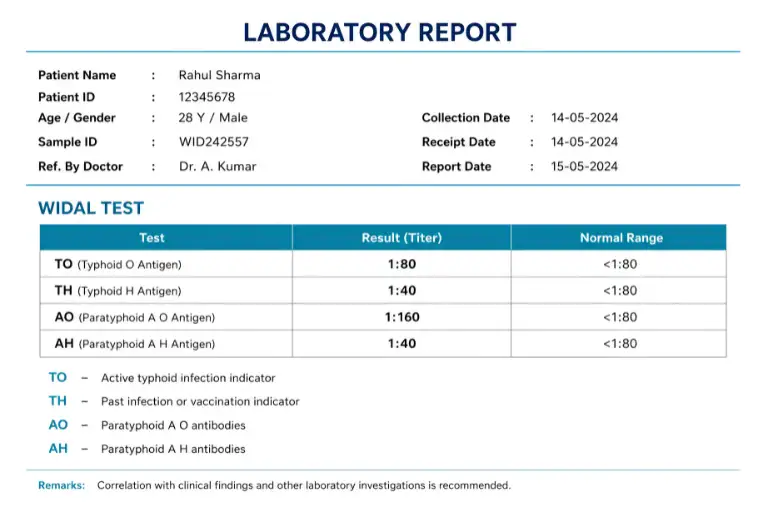
Your Widal test report measures antibodies against two bacteria: Salmonella typhi (typhoid) and Salmonella paratyphi A (paratyphoid). For each bacterium, the test looks for two types of antibodies:
O antigen (somatic): Comes from the body of the bacteria. Rises quickly in active infection, within the first week of fever, and falls quickly after treatment.
H antigen (flagellar): Comes from the tail of the bacteria. Rises a little later but can stay in your blood for months or years after recovery. Also rises after typhoid vaccination.
So your report has:
| Row | What It Measures |
| TO | Typhoid O antigen antibodies |
| TH | Typhoid H antigen antibodies |
| AO | Paratyphoid A, O antigen antibodies |
| AH | Paratyphoid A, H antigen antibodies |
In most typhoid cases, TO rises first and rises higher. If TH is elevated but TO is normal, you were likely vaccinated recently or had typhoid in the past, not an active infection now.
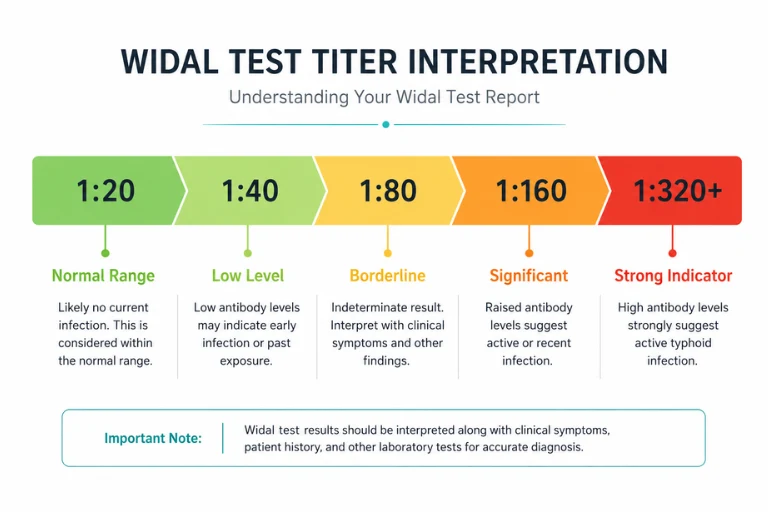
The Widal test normal range in most Indian laboratories is 1:20 for both O and H antigens. Here is what values above that baseline suggest:
| Titer Value | What It Suggests |
|---|---|
| 1:20 or below | Normal, within expected range |
| 1:40 | Low level, monitor alongside symptoms |
| 1:80 | Borderline, needs clinical context |
| 1:160 | Significant, likely active infection |
| 1:320 or above | Strong indicator of active typhoid |
The Widal test normal range is a starting point, not a verdict. In cities like Ranchi, Patna, Jaipur, and Lucknow, where typhoid is common year-round, doctors often use 1:160 as the minimum threshold. In lower-endemic areas, a result of 1:80 gets more attention. This is called the endemic baseline.
A titer of 1:80 is one of the most commonly misread results on a Widal test positive report. In someone with no fever, no stomach pain, and no fatigue, 1:80 is almost always a residual reading from a past infection or old vaccination.
In someone with five or more days of fever, evening temperature spikes above 102°F, and loss of appetite, a TO reading of 1:80 is more meaningful and warrants further testing. Without symptoms, it is usually not typhoid. With symptoms and prolonged fever, your doctor will likely order a blood culture to confirm.
A TO titer of 1:160 is four times the Widal test normal range baseline. Research published in the Journal of Clinical and Diagnostic Research found that combining titer values with clinical symptoms significantly improved diagnostic accuracy compared to relying on the Widal positive report alone. The same research found that using the test in isolation led to incorrect antibiotic prescriptions in a notable share of cases.
Correct Widal test report interpretation always involves more than just the number. Your doctor needs your fever history, symptom duration, and in most cases a blood culture before making a treatment decision.
A Widal positive report does not automatically mean you have typhoid. Several conditions can push the result above the normal range:
This is why doctors in India rarely diagnose typhoid from the Widal test alone.
The same titer reading means something different depending on how long you have had fever:
Day 1 to Day 3: The test often comes back normal or borderline, even with typhoid, because antibodies have not risen enough yet.
Day 5 to Day 7: Antibody levels peak. This is the ideal window, when a titer of 1:160 or above carries the most weight in Widal test report interpretation.
After Day 10 or after antibiotics: The test becomes less reliable as treatment reduces antibody levels.
A rising titer — for example, 1:80 on Day 3 rising to 1:160 on Day 6 — is more meaningful than a single high reading.
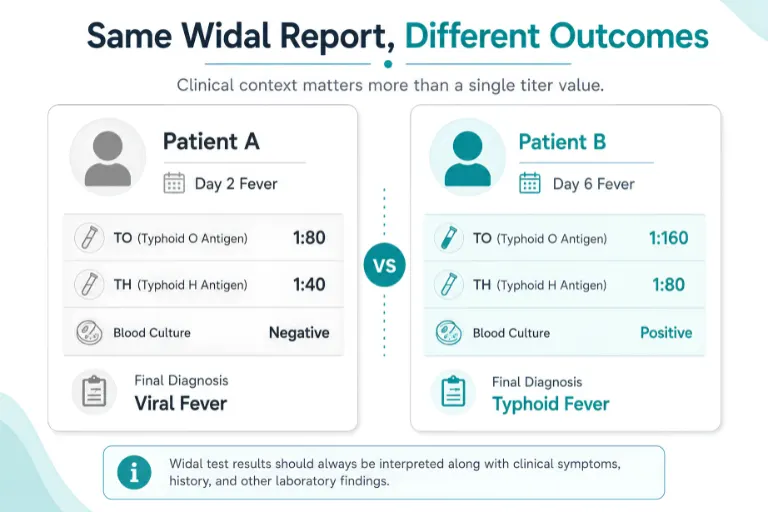
Patient A: A 19-year-old student in Ranchi on Day 2 of fever (100.4°F). Widal shows TO 1:80, TH 1:40. The doctor repeats the test in 48 hours. Result rises to 1:160. Blood culture ordered, negative for Salmonella. Final diagnosis: viral fever. Recovered without antibiotics.
Patient B: A 32-year-old man in Ajmer on Day 6 of continuous fever (103°F evenings). Widal shows TO 1:160, TH 1:80. CBC shows low white cell count, a known feature of typhoid. Blood culture confirms Salmonella typhi. Treated with azithromycin, recovers in 10 days.
Same titer value. Completely different outcomes. Context is everything.
Bring your Widal test report along with details such as how many days you have had a fever, whether it rises in the evenings, any stomach symptoms, recent typhoid vaccination, or prior antibiotic use. This information helps your doctor interpret the results more accurately.
If your fever has lasted more than five days and your report shows elevated values, read our guide on typhoid symptoms, treatment, and recovery to better understand the next steps.
The normal Widal test range is usually 1:20 or lower for both O and H antigens. Higher values should be interpreted alongside symptoms and fever history.
A Widal positive report indicates antibody levels above the normal baseline. It does not confirm typhoid and should be evaluated with symptoms and additional tests.
A result of 1:80 is generally considered borderline. Without symptoms, it may be insignificant, but a prolonged fever often requires further evaluation.
No. Fasting is not required before a Widal test. The blood sample can be collected at any time of day unless your doctor gives specific instructions. If you are unsure, call our team before your visit 796 929 4525.
The best time to get a Widal test is between Day 5 and Day 7 of fever, when antibody levels are typically high enough for reliable results.
The Widal test normal range is usually 1:20 or below. A result of 1:80 is considered borderline and should be interpreted alongside symptoms and fever duration. A TO value of 1:160 may indicate a possible active typhoid infection and often requires further evaluation. Because a Widal test alone cannot confirm typhoid, doctors also consider blood culture results, CBC findings, and clinical history.
If you have had a fever for more than five days or received a Widal test positive report, our doctors at Vardaan Hospital, Ranchi, can help you understand your results and recommend the appropriate next steps.
📞 796 929 4525 | ✉ [email protected]
📍 Block Road, Kathi Tand Chowk, Ratu, Ranchi
Vardan Hospitals © 2025. All rights reserved.